


In 2010 the USDA uncapped their figures: 2009 yielded the lowest recorded U.S. honey crop ever. EVER. What is happening to the bees? The bees certainly seem to be going through turbulent changes right along with the rest of the world. Will the honeybee adjust and survive?
You can blame some of the low honey crop that year on the weather. Mother Nature is not always in sync with the bees. Sometimes she brings rain when the bees need clear, dry skies. My beekeeping husband moans when the spring showers, that I love to immerse in, flow through just as an important nectar crop is ready. The bees don’t have umbrellas and cannot work in the rain. Yet, a lack of moisture is not good for them either. If the pollen-bearing trees and plants go through a drought one year it can affect how much nectar is produced for the bees to harvest the following year.
A grand dance of interconnections is continuously going on, of which we are also a part. Just as nature is not always in sync with the bees, neither is humankind. If we spray our trees and plants with herbicides, pesticides, and fungicides and insist on maintaining plain grass lawns, lacking in plant diversity, the bees suffer.
Of course, everyone has heard about the mysterious, disappearing bee phenomena named Colony Collapse Disorder (CCD). They say that recently more than one out of three bee colonies have died due to CCD nationwide. Ironically, we have one thing for which to thank CCD. CCD has brought an awareness of the honeybee to the general population. Before CCD arrived on the scene most people didn’t want to have anything to do with any kind of bee. All flying insects were simply swatted, sprayed or squashed. Now people have become aware of the unique role of the honeybee and are learning about the other bees also such as—native pollinators—carpenter bees, and the friendly bumblebee.
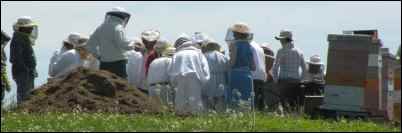
Setting up at market selling honey, we have had a large increase during the last few years in the number of people that inquire about the welfare of our bees. Today’s crowd is honeybee savvy. Beekeeping has become more highly esteemed and the job of being a beekeeper has been elevated. Now, with new awareness, people try to locate beekeepers to extract honeybee colonies out of structures where they would have blindly sprayed before. People have become interested in the survival of the honeybee and we are linking the fate of an insect with our own future. We are seeing that we are all connected, you, me and even the bees. People are coming together for a common cause, to save the honeybee.
Nobody said that it was going to be easy. Apiculture—better known as beekeeping—is a gamble, it always has been. Like any type of farming, to be a beekeeper means that one takes chances with the weather, seasons and pestilence. When all else fails, you hope that luck is mostly on your side. At our homestead in southeastern Ohio we have not had a real productive honey crop in quite a few years. We ran out of honey to sell before Christmas last year leaving our faithful customers with empty honey jars.
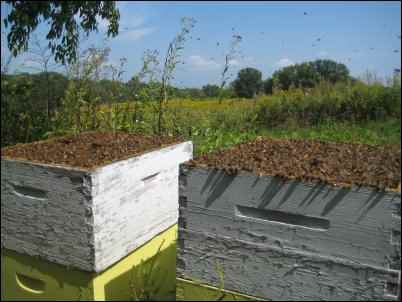
June, the time of the first honey harvesting, is fast upon us. Perhaps this year will provide higher yields? It is not starting off so well. I heard grumbling from my beekeeper when he came stomping in after checking his hives early this spring. Our bees didn’t put up enough in their autumn forage and some did not survive the long, steady winter of 2009. Most apiarists—or beekeepers—in these parts lost hives this winter, some lost up to seventy-five percent, so they started out this spring with less populated apiaries. Perhaps they will dig in and invest in more bees or they will be blessed enough to catch lots of swarms. Or maybe they will give up the bee wars of mites, disease and weather. Only time will tell. With all of this discouragement it is no wonder that not only are the bees disappearing but so are the beekeepers.
The majority of beekeepers are old-timers: the average age of a beekeeper is 60 years old. There are hardly any new faces at the bee meetings and bee groups; their members are dwindling. Is beekeeping becoming a dying art? Beekeeping is a lot of work. Loaded frames of honeycomb are heavy to lift, extracting is monotonous, getting stung is a given, and the bees need lots of maintenance all throughout the year. So what is there to inspire a person to become a beekeeper?
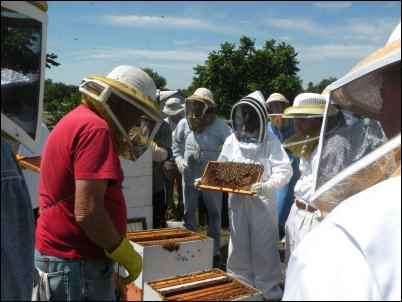
From the times of ancient history the art of beekeeping has been in a world of its own, a world shrouded in mystery. As the smoke from the smoker engulfs the veiled beekeeper’s head like a halo; a mysterious haze shrouds the secrets of their occupation.
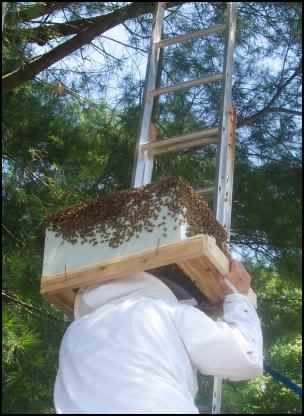
When a beekeeper arrives at the location of a swarm and seems to charm the wild bees into a box I have heard these words exclaimed with excitement many times, “See the magic way he has with the bees!” Is it magic, science or a touch of both? Whichever, beekeeping is an endeavor that is chosen and sustained by only a few brave men and women… or are they the ones that are chosen? In the old days, the art of beekeeping was handed down from generation to generation, but when the youth left the farms for the cities in the industrialization age, the beekeeping tools were left behind. The art remains now only to be picked up by those who are called forth.
I remember when I first started to become aware that beekeeping is not just an occupation or a hobby to pass the time of day. My husband—a new beekeeper—was buying used equipment from a retired beekeeper whose face was beaming with humor. The old-timer gave me my first hint that people keep bees because it is a passion for them when he said with great fervor in his voice, “You are about to enter a whole new world!”
Is it a world that will someday no longer be? There is one who would wish otherwise and is demonstrating a sincere passion\/n for beekeeping. Christopher Stowell is a 13-year old boy in Boy Scout Troop 250 of Skiatook, Oklahoma. Christopher wanted to do beekeeping for a merit badge only to find out that the Bee Keeping badge had been discontinued in 1995. Christopher called the National Boy Scout Council where he was informed that there is not enough interest anymore in beekeeping in America. Christopher wrote a letter to his local bee club stating that if youth are not encouraged to become beekeepers the art will die out.
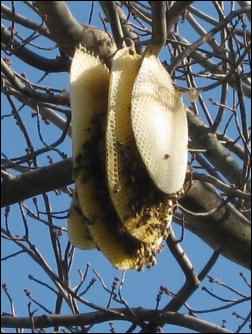 Christopher’s cause has been taken up by beekeeping clubs across America. They are recruiting mentors to tutor the youth. Christopher is now working on a proposal to the National Boy Scout Council and getting a petition signed to support the reinstatement of the beekeeping merit badge that is to be discontinued on July 15, 2010. Recently his petition has drawn national attention and Haagen-Dazs (the ice cream company) is giving Christopher a boost with their Help the Honey Bees campaign and The Experience Project has a Bee-lieve in Beekeeping and Help Save the Honeybee project.
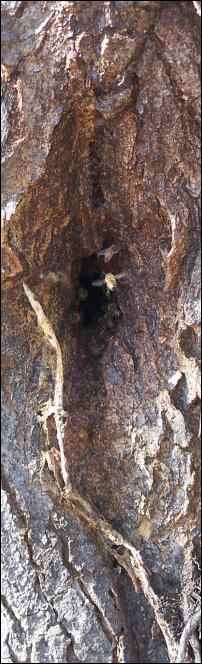
Signing Christopher’s petition is just one way that we can help save the honeybees. There are many things that we can do right in our own backyards. I think that the answer to how to save the honeybee comes from the bee itself. The honeybee is trying to tell us her secrets by the life that she leads. A honeybee lives for the good of the whole. She is not a member alone but serves as a part of the community. We humans have become very good at classifying, categorizing and specializing. We have become very independent and individualized while the honeybee’s whole life is dedicated to the common good. We spray poison on our apple trees because we hate to see a worm. Yet we fail to consider how every little butterfly, bird, and bee that passes the way of our apple tree gets to eat the bitter poison that we spray. How do we expect the honeybee to do well when she must drink toxins from our fields and lawns daily and is deprived of biodiversity in the plants that she can forage? Can the honeybee be healthy when she must live on a mono diet as when she is placed in mono-crop fields or near-endless lawns of grass?
We would do well to leave natural areas on our lawns and property where native plants and trees that are beneficial to honeybees can grow. Honeybees are fond of many of the herbs that come up naturally from the ground: ground ivy, dead nettle, dandelions, clovers, sunflowers, asters, goldenrods, redbud, and quince, just to name a few. There is an endless variety of plants that are nourishment for the bees and which will grow wild and free if we allow them room. It is not hard to find out what native plants serve the bees in your area. Visit a local nature preserve and talk to a naturalist. Call your local extension office or look your state and native flowers up online. Some people are allergic to bees so grow bee plants away from paths where people might travel.
Having bees in our yards is greatly beneficial for the pollination of our fruit trees and flowers and provides habitat for a host of other interesting wildlife, tree-frogs, crickets, toads, praying mantises, birds and butterflies to name a few. A great variety of garden flowers attract honeybees, such as sunflowers, borage, lilacs, lilies of the valley, nasturtium and chamomile. A bit of research will lead you to many more.
Honeybees also need fresh, pure sources of shallow water. They use water to cool down the hive on the hottest days and to thin the honey when feeding their young larva. In our yard, we see honeybees on their forays of water collecting just as much as we see them buzzing around flowers. It is estimated that a strong hive uses over a quart of water a day which means 800 working honeybees each making 50 trips each to the waterhole. And we think doing dishes is a chore! We can supply these thirsty bees some water holes by placing small bowls or trays of water placed in safe areas, where they can easily be replenished with the water hose or rain showers. Honeybees can easily drown so the water stations must be shallow with sticks, stones or plants that the bees can walk out on to gather water from. Our beekeeper keeps a watering trough wet, which has little sections only about an eighth of an inch deep for the bees to gather water from.
By offering honeybees a pesticide-free environment with rich, organic soil bearing a diversity of plants, and by supplying them with a source of clean water, we can do our part to help save the honeybee and we will also be helping out our local beekeepers. Honeybees travel within a two to three-mile radius from their hive to forage so there is a good chance that your yard is potential food, good or bad, for a bee near you. What do you have on the menu for her?
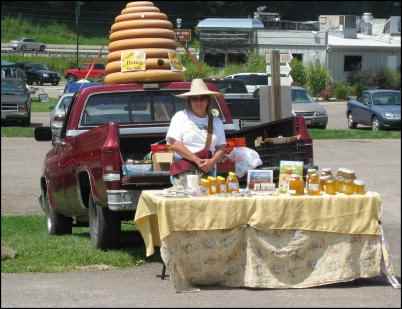
If you are interested in keeping bees you can contact your County Agricultural Extension Office for information about local beekeepers and bee-keeping associations.
May the honeybee AND the beekeeper live on.
“A swarm of bees in May is worth a load of hay.
A swarm of bees in June is worth a silver spoon.
A swarm of bees in July is not worth a fly.” Ancient May Day Proverb
When it is too late, it is too late.
Thank you for writing this! I appreciate you trying to inspire a new generation of beekeepers as well as letting non-beekeepers know what they can do to help! As a beekeeper, I want to say “Thank you!”
For anyone on the fence about jumping in, go for it! It is an amazing journey!