


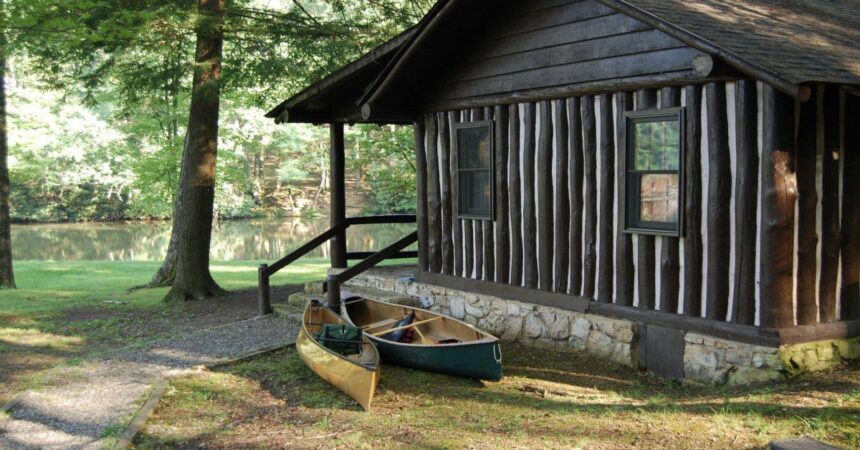
Cover photo credit to Virginia State Parks
When I first saw my house, I thought it was just a simple wooden house covered in vinyl siding. Then I ventured around back and saw a small area where a piece of siding had been removed to expose its real core material: logs. But not logs laid horizontally as with most log cabins, but logs standing up vertically.
I personally had never seen a log cabin constructed like this before. I’d always known log cabins to have their logs laid out like Lincoln Logs, horizontal and interlocking. But while I thought this style was unique, with a little research, I found that these cabins have been made by different people from various cultures around the world throughout history. I found references to Swedish cabins built with vertical logs in early settlements, as well as in Hungary, where my ancestors originate, and in France and Canada.
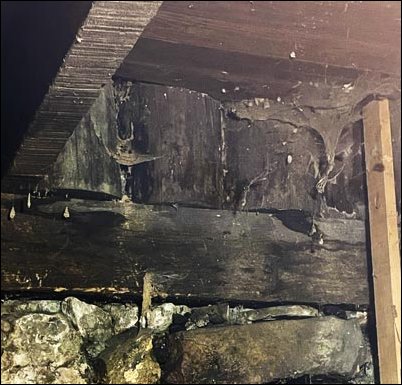
I found several companies that build cabins of this sort today, branding them with references to their origin. For example, Caribou Creek Log Homes can build you a Swedish vertical log cabin and refer back to its roots in Sweden, where they used a “full scribe” method of making grooved and interlocking logs that are erected vertically.
I also found a company called Canadiana (no, that’s not a typo—it actually does end with the letters I-A-N-A.) that can build you a Canadian style vertical log cabin, because they say the style of construction has deep roots in Canada (New France), where French colonists built them along fur trade routes because they were easy to build and used what trees were available on site. They refer to it as Canadian vernacular architecture, meaning an architectural style that is designed based on local needs, materials available, and using local traditions. Originally, vernacular architecture relied on the design skills and tradition of local builders rather than formally schooled architects.
I also found that many refer to this style of cabin as a stockade cabin, which brings to mind forts known as stockades built by the cavalry and seen as strong protection from enemies. One might note that the fences built around the forts to protect them from the enemy were also built with upright logs. I guess I’m saying that this type of structure has often been used where strength was most needed.
When I bought my house, most of the other people on this hill were part of one family, so I was able to ask about who built it, and I found from a relative, Sarah Shelley, that it was built by her great aunt, Lyda Aliff Carroll. Personally, I found that really inspiring for me as a woman, but also pretty amazing. Not because I don’t think women can do anything men can do, but because it was built in 1931, when most women weren’t allowed to do much themselves. (We got the right to vote in 1920, but we didn’t get the right to have our own checking accounts until the 70s, so I imagine it was her husband who had to sign for any loans that may have been needed for materials.) And she did have a husband, so he may have also helped her with the lifting and such. I don’t know. I’ll just put this out there for any relatives who happen to have more information on the building of this house. I’m interested! Let me know. One of the great things about Homestead.org is that they are willing to let writers add to their stories over time, and I will do just that to correct any errors or add additional information you may provide.
So… back to the ease of building it.
First of all, these cabins are usually built using the trees that exist on the building site. This is possible because the method uses smaller trees in both length and width, which are possibly more abundant, or at least, from my experience, a lot easier and less dangerous to fell. These cabins are built using logs that are about 8 feet long, just high enough for a one-story cabin when stood on end. One needs only to dig a shallow trench and line up the logs, standing each one on end, and put chinking between the logs, or sometimes slats of wood (board) are used to connect the logs. Mine had chinking that was held in partly by lots of long nails. I’m assuming she put the nails in to add something for the chinking to hang onto and then smeared it on.
I’m not sure what type of machinery she might have had available. At first, I thought that it might be a little difficult for a single person to stand an 8-foot log on end, until I noticed that smaller diameter logs are usually used as well.
Another advantage is that by adding logs this way, you can make the walls of the house as wide as you want them to be. If you want to build a small cabin, use fewer logs. If you want to add on, add some more logs. With a standard log cabin with logs laid horizontally, you pretty much need to decide on a size and stick with it. That means that if you want to build at 10 foot wide house with horizontal logs, you need to have 10-foot-long logs, a 15-foot house would need 15-foot logs, etc. Those trees would be harder to cut down, harder to lift, and maybe harder to find on site.
And lastly, I found a few advantages, or perhaps only perceived advantages, to their sturdiness once they are built. With vertical logs, there is less shrinkage around doors and windows as the house ages and settles. Apparently, when logs age, they shrink in diameter, which pulls the horizontal logs downwards around door and windows sills and can cause some problems, but by propping the logs up vertically, the shrinkage just slightly increases the gaps between the logs and you can add extra chinking to make up for it, unless you decide to get really fancy and fill in with interlocking boards. Logs don’t shrink as much lengthwise.
Some think water would be more likely to permeate the logs from the end, while others have noted that a simple two-foot overhang from the roof would solve this problem. Personally, I thought that all houses had good-sized overhangs. The overhang on mine looks to be about a foot and a half, and I haven’t had any problems with water dripping under it.
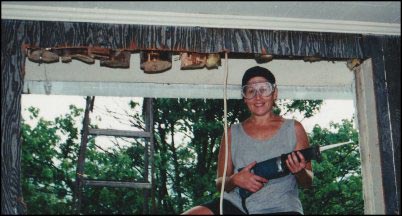
I’ve always told myself that my house is sturdier with its thick logs as opposed to frame houses, and I like to think that it might even be able to withstand certain weather events better than cabins with horizontal logs. After hurricane Helen felled numerous trees in the forest behind my house, I began thinking of what might happen if one of those trees had fallen on my house. This is just my theory, well, actually I think I found a few others who backed me up, but I believe that the vertical logs would hold up better if a tree fell on my house because, if you think about it, it is easier to break a stick by hitting it in the middle than it is by hitting it on the end. But then I cut a few holes in the house to add extra windows, so that kinda ruins my confidence in the stability of this particular house.
Unfortunately, using younger, smaller trees has one disadvantage. I have found sources that say older trees have more heartwood than sapwood, and heartwood is what builds a tree’s resistance to insects and moisture. As a result, trees with more heartwood are said to be more stable and durable. But then, many other things can affect the strength of the logs, too. For example, I’ve read that trees that are grown in high altitudes have more heartwood than trees growing in lower altitudes. I live in Bluefield, WV, where the altitude is 2,611 feet above sea level, which is higher than some since we are a mountainous region, but not terribly high. And of course, you could also consider that different species of trees, such as oaks, have harder wood. Or you can stop analyzing the situation so much and just use the trees around you. I like to think that is how Lyda Aliff Carroll felt when she built mine.