


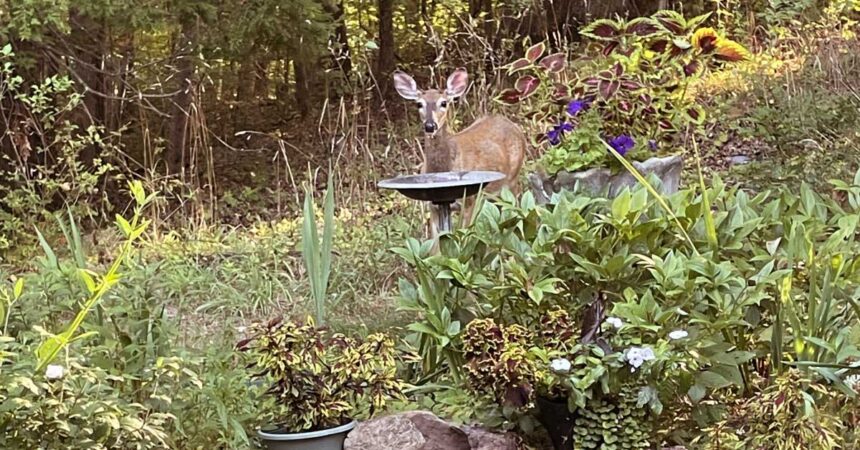
Are the deer eating all the flowers in your garden? Is there just not enough sunlight? I’ve finally found the solution to both of these problems and possibly a way to make some extra money and the answer is Coleus! Deer don’t eat coleus, and coleus doesn’t mind shade. And as it turns out, you can propagate it from leaves much faster than growing it from seed. In fact, if you have the space, you can keep making them multiply over the winter so that you have tons ready to plant in the garden come spring, or even sell at the local farmer’s market.
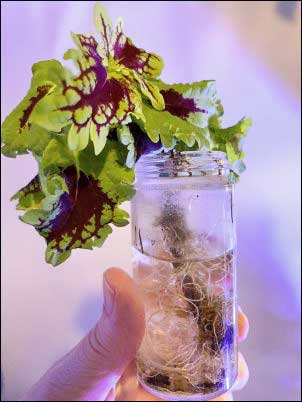
All you have to do is take a cutting of a coleus plant, leave a couple of leaves on top and pull off some leaves near the lower part of the stem so that you have two or three nodes for roots to grow from. Then dip it in rooting hormone, stick it in water, and it will start producing roots within a week.
There are several rooting hormones on the market by names like RootMax and Rootboost. I can’t speak for them all, but I assume they are much the same. For years I was using RooTone and I’m currently using TakeRoot. Apparently, some (including RooTone) do contain a fungicide as well.
Once the roots develop, you just need to keep adding water each day because these little boogers are thirsty! I have never known a plant that is such a heavy drinker. And once they’ve developed a healthy set of roots, you can put them in pots with dirt and start trying to find places to put them all. I’ve propagated so many over the winter that I’m now hanging them from my ceiling in old coffee cans.
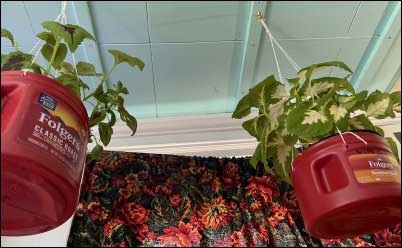
Why? Well at first it was to save money and get a jump on the short growing season in West Virginia, but then it became more of a passion … or an addiction? It fulfills in me some need to nurture, although I already have that fulfillment with my sweet cats. Maybe it is the idea of continuing life from generation to generation within a span of months. For me, this propagating coleus is like keeping a fire alive by passing it from torch to torch. I just can’t quit carrying on the life of that first seed planted last spring.
In a way, I find it much more satisfying to be watching these roots grow in clear water right before my very eyes than looking at a container full of dirt and wondering what may be happening with the seed you put in there last week.
Okay, I’ll stop being philosophical now.
The origin of the story is that for years I’ve been working on building a perennial flower garden where I have at least a few flowers blooming at once throughout the summer, but it has been 30 years since I moved into this house and the trees have branched out considerably. In the summer their leaves are blocking out more and more sunlight from my little circular flower garden and pond positioned in what used to be the sunniest part of my yard.
So keeping blooming flowers going has been a bit of a struggle, and then there are the deer. I live in a wooded area, and I love everything that comes with it: the deer, the racoons, the groundhogs, the possums, the squirrels, the occasional snake brought to me in the mouth of a cat. I love it all, and I’ve been torn about the deer eating my plants and flowers for many years. I enjoy seeing them out there grazing on the leaves of the bushes and natural grasses I let grow along edge of my yard near the forest, but when I’m smiling and gazing out the window and I see them start moving in closer and munching on my flowers, I end up banging on my window to scare them away. Then I feel a little elated to see them bounding off with their white tails flashing but lament the fact that I don’t get to watch them graze anymore.
So, I did some research into flowers that deer don’t like and found coleus. And yes, I have found that they will totally ignore it even while chomping down a hosta right beside it.

For a few summers I planted lots of coleus in my garden, starting it from seed and waiting for quite some time before they were big enough to be showy. Then I started wondering if I could somehow propagate them over the winter so I wouldn’t have to start the whole seed growing process over again, and it has worked like a charm. And even though they are shade tolerant, they aren’t averse to sunlight. I have some growing on bright windowsills and some under grow lights in a cabinet.
I was first attracted to coleus because of their deep, rich, red leaves complimented with bright green edges. I also love the fact that the leaves are pretty all of the time as opposed to blooms on plants that may last two weeks. Then I discovered that there are many more varieties of coleus than I was originally aware of. I found these beautiful frilly-leaved ones last summer, and then I also found bright yellowish green coleus and coleus with more lance-like leaves.
Apparently, there are over 300 different species of coleus and over 1,500 varieties, and they come in many, many different shapes and colors. It’s just a matter of where to find them. I’ve only found four varieties in the local garden stores around here so far, but I’m in a small town, and there is always the online ordering world.
Continuous Care for Coleus
Once you are growing your coleus in a pot or in the garden, two things you might want to remember are that they are still heavy drinkers, and if you miss a day or two of watering, they will droop quickly.
Coleus flowers are just small spikes of not very bright or showy flowers that most people just cut off, and cutting them off inspires more leaf growth. I did leave a few flowers last summer just for variety and perhaps something for the bees.
Coleus looks better when it is occasionally trimmed of its aging faded top leaves, as the younger leaves are richer in color. So, if you want to save those trimmings to make even more coleus, more power to you!
Rooting other types of plants
Over the years, I’ve found that it’s hit and miss sometimes with propagating plants, which I guess is why I’ve been so enthused about coleus. I can see results within days as opposed to weeks with something like pothos, or never with certain things I’ve yanked up on the side of the road in hopes of cultivating.
I have a small wisteria bush that is in an unsunny part of my driveway, and I’ve made numerous attempts to clone slips from it so I could plant one in a sunnier spot, but to no avail.
When I decided to browse around on the internet for more research on propagating plants in water, I found opinions that woody plants don’t propagate well in water, which makes sense considering the wisteria.
Woody plants are said to be better suited for soil propagation, and that I believe because I have found the easiest way to propagate forsythia is to just to bend a few lower branches down into the ground so they can root themselves while still drawing energy from their original bush. I tried that with the wisteria, but the branches were too stiff to bend to the ground.
There is also a plastic egg-shaped thing you can buy that clamps around a branch of a bush for trying to root that branch. It is best to either trim off a leaf to get a node for root growth or nick and peel some of the bark off in that area. Rub on some RooTone, then put some growing medium such as sphagnum moss (something that retains moisture but also drains well) in the container and clamp it together over the branch. I bought a few and attached one to a beautiful peach-colored Flame Azalea that I found growing in the woods. Unfortunately, I haven’t been able to find that tree since because I can only recognize it when it is blooming. Oh, well. Some day I might walk into the woods at bloom time and see it.
Others have suggested that it is cheaper just to use a plastic bottle or wrap some plastic wrap around the branch to hold the growing medium, and that sounds like a good idea to me.
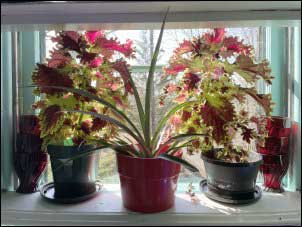
Succulents are also said to be better not rooted in water. Pineapple plants are succulents, and I have a pineapple plant that I rooted from the top of a store-bought pineapple. I just put that one directly into the dirt after brushing on a little RooTone and kept watering it and watching it. At first, it was hard to tell if it was actually growing or if I was just keeping the top green, but after a while,e I started seeing new leaves and it has finally visibly increased in size. I’m not sure if I really have delusions of being able to grow it to a full-size pineapple plant or expect it to start bearing pineapples, but I enjoy the spikey foliage. I’ve seen YouTube videos that indicate it grows much faster, especially if you grow it in a bucket outside in a sunny area. If I can find a sunny area, I might try to boost its growth that way this summer. I wonder if deer eat them… a quick check with the internet says, “Yes.” Darn! I guess I’ll keep it in a pot inside.
