


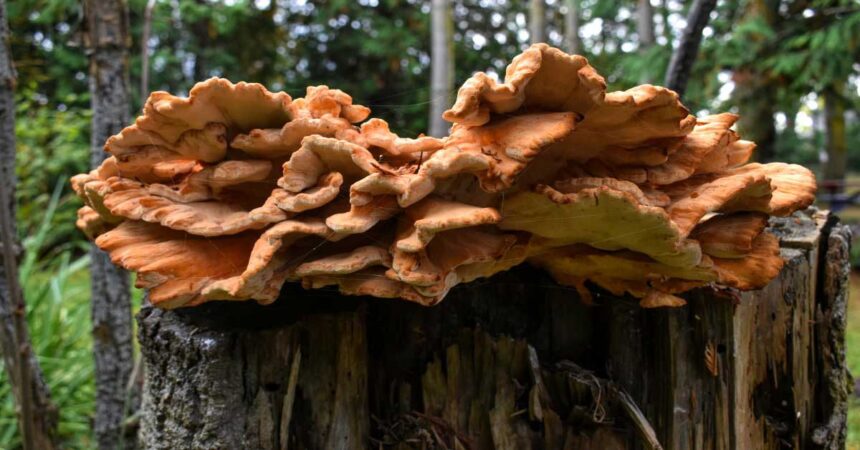
You might have woods and you might have hens, but do you have “hens of the woods”? If you search your homestead for the answer, don’t even bother looking for feathers. These hens don’t molt. Neither do they move about in their mature stage, so if you do spot one, catching it should be easy. Also, don’t trouble yourself checking for eggs when you seek this fowl. Instead, you’ll be looking for a dose of good eating and health benefits from — a mushroom. And a pretty special one at that.
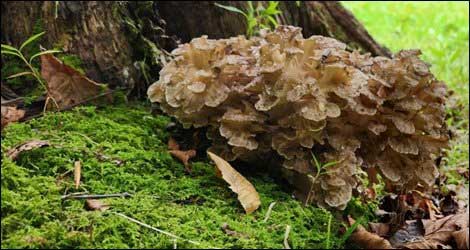
Another handle for this fungus, besides “hen-of-the-woods” and its formal name Grifola frondosa, is “maitake.” It’s a Japanese moniker translating to “dancing mushroom.” So if the thing doesn’t move, why call it the “dancing mushroom”? There’s an easy answer. The mushroom doesn’t cavort — the finder does. Those who hit upon a maitake are overjoyed and can’t help but dance at such a glorious find, so the legend says. And it makes sense.
But there’s another question. Why do we have a Japanese common name for a mushroom that grows in North America? Unlike many plants, animals, and other organisms that humans have introduced, either deliberately or inadvertently, maitake occurs naturally in both North America and Japan. The same is true of many other kinds of mushrooms, owing to their tiny spores that achieve transglobal travel on atmospheric currents.
Speaking of tiny, we’re fortunate here in eastern Connecticut to live on a little 30-acre slice of the globe. It’s mostly wooded and includes a mixed conifer-hardwood forest. Since there’s way more to a forest than just trees, we discover lots of interesting things as we explore the area. But during late summer and through fall, we focus more and more on maitake mushrooms.
(Incidentally, I’ll refer to maitake in both the plural sense and singular, depending on context.)
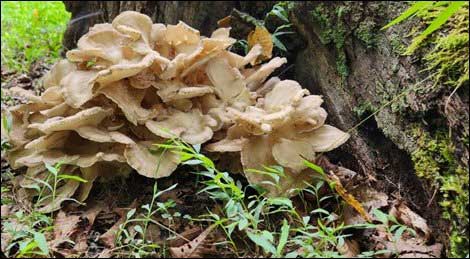
We look at oaks. More specifically, we look at the bases of oak trees, especially those with signs of decline. That’s where maitake typically turn up. The mushrooms are fairly camouflaged, often with a mousy color and a texture that breaks up their appearance. And that means from a distance they can look a bit like a brownish, dying fern frond (or a drab-colored hen). Don’t be fooled — look closer and you might be delighted. Whether you do the Japanese version of the jig or not is up to you. (It’s not a requirement but merely a suggestion.)
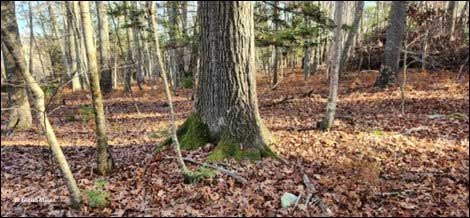
In our neck of the woods, these hens occur on trees in the black or red oak group, including black, red, and scarlet oaks (Quercus velutina, Q. rubra, and Q. coccinea). I don’t recall that I’ve ever found maitake on a white oak or on a tree species other than those in the black or red oak group. Perhaps in other regions they aren’t quite as picky.
They’ll show up at a standing dead tree, on a stump, or even a live tree. While maitake are parasitic, they aren’t especially aggressive in that role compared to other fungi and are often “happy” to gain nourishment as saprophytes, decomposing dead tissue. Given an opening like a basal wound, they will infiltrate the interior of a live tree and feed on the dead or mostly dead heartwood.
Our oaks here are in various stages of decline. Chief among the reasons for this is a rash of spongy moth (formerly gypsy moth) outbreaks. Defoliation, even if partial, takes a toll and even healthy-appearing trees are usually compromised to some degree. We’d much rather see live and thriving oak trees than dead and failing ones, but the tradeoff is good maitake hunting.

So what’s all the fuss about? First, maitake is a choice edible and many mushroom lovers find them delish. Professional chefs seek them out for stews and soups, side dishes, appetizers, and the like. Among this mushroom’s other claims to fame are health benefits. Researchers have studied Grifola frondosa extensively and though they don’t necessarily consider the fungus a panacea, the list of ailments it stands to mitigate is impressive. For starters, maitake can purportedly reduce cholesterol and help lower blood pressure. But the benefits go beyond hearsay and anecdotal reports. A literature review in the science journal Heliyon published in April 2024 on maitake states:
“The evidence presented underscores their effectiveness in combatting various health conditions, spanning from cancer and diabetes to immune disorders and skin ailments. Notably, key bioactive components, particularly polysaccharides, play pivotal roles in eliciting diverse health benefits, including antitumor, immunomodulatory, antimicrobial, anti-inflammatory, antidiabetic, lipid metabolism regulation and antioxidative effects.”
That is researcher-speak for, “It seems to be pretty darn good for you.”
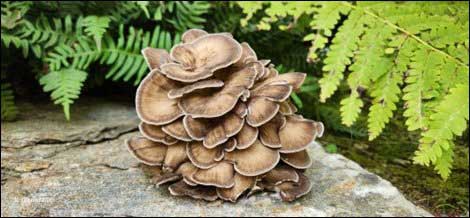
Fresh maitake fetches a hefty price. Several things factor into the retail cost for a pound of this mushroom so it can vary, but around $30 is probably a “reasonable” average these days. In years past, when we had plenty, we sold some to our local food co-op for the going wholesale price, though I don’t recall what that was at the time. I do remember the buyer we dealt with telling us that the store had a customer who was especially keen to get maitake and that she would make her own medicinal extract from it.
Wild-caught hen of the woods prepared by a chef and finding its way to your plate in a restaurant will set you back. (I don’t know that from experience since I’ve never had it in a restaurant, but my son-in-law is a chef, and we sometimes gift him part of our haul.)
We’ve had lean seasons and bountiful ones here. We’re currently having an extended dry spell in our region. One common thread of mushroom hunting is expecting a bloom after rain events. While that can prove reliable in general, it’s not always necessary. Old tree stumps seem to have the ability to serve as reservoirs, holding moisture even when surface conditions are parched. We’ve found plump, premium maitake blooms in very dry conditions.
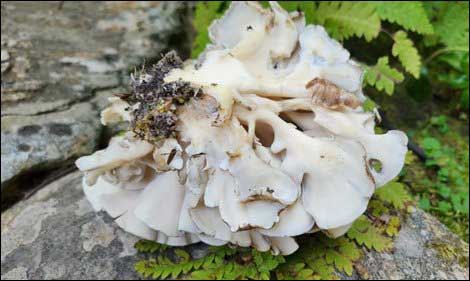
Of course, as with many things, there are multiple factors that enter into mushroom foraging in general and maitake hunting in particular. In that spirit, the thing to do might be not to overthink things or focus too intently but rather to just go for a leisurely stroll through the woods with only the notion in mind and an awareness of your surroundings. An unexpected or almost unexpected find can often be the best kind.
And who knows, it might even make you dance.
Parting Thoughts
Here’s an aphorism that’s worth reciting every time wild mushrooms and their consumption comes up: “There are old mushroom hunters and there are bold mushroom hunters, but there are no old, bold mushroom hunters.” Fortunately, maitake is hard to mistake for other mushrooms. It’s not impossible, but the true lookalikes are not dangerous—they pretty much just don’t taste as good. Still, with wild mushrooms, it’s wise to heed the admonition and never just say, “I’m feeling lucky.” After all, you might want to live to dance another day.

A Brief List of Potential Hen of the woods or Maitake Mushroom Lookalikes (All Edible)
Black-Staining Polypore: The black-staining polypore tends to be lighter colored than maitake with thicker caps or lobes that stain black when bruised or handled.
Berkeley’s Polypore: Berleley’s polypore is also generally lighter colored and has larger, fleshier, ear-shaped caps or lobes than maitake.
Eastern Cauliflower Mushroom: The eastern cauliflower tends to have a rounded growth habit with coral-like or brain-like folds.
