


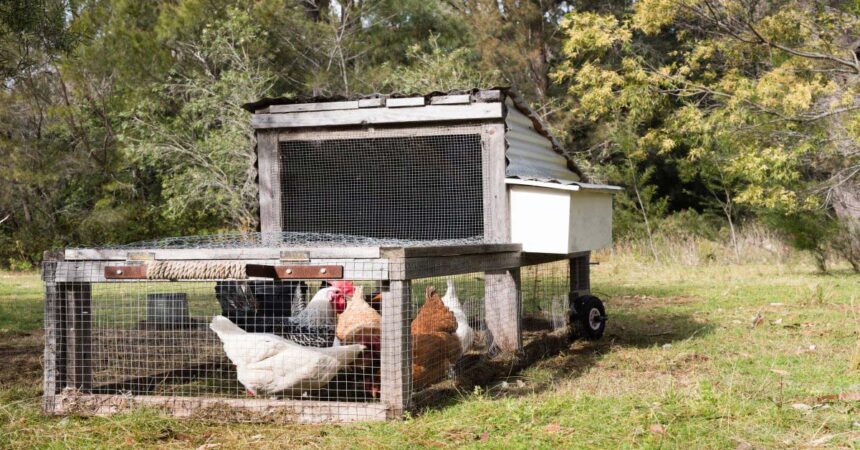
In a world where agriculture is increasingly defined by algorithms, genetically engineered seed, and machines that cost more than a suburban home, it feels almost rebellious to return to something so modest as a mobile wooden box on skids. Yet that is exactly what is happening in backyards and small farms across the country. The chicken tractor, a humble contraption that relies less on technology and more on the simple instincts of hens, is quietly staging a comeback. It is not just a novelty or a nostalgic throwback. It is a practical solution to some of the deepest challenges of modern homesteading: how to build soil health without chemicals, how to cut costs when feed prices soar, how to keep flocks safe while still letting them express their natural behavior, and ultimately how to reconnect with the land in a way that feels both responsible and sustainable.
The term “chicken tractor” was popularized in the 1990s by Joel Salatin, the iconoclastic farmer who believed that animals were not units of production but collaborators in an ecological system. His insight was simple yet transformative: give chickens mobility. Place them in a coop light enough to be moved daily, roll it across the pasture, and watch what happens. The birds scratch, peck, and fertilize the ground with almost military efficiency. They hunt out pests, turn over topsoil, and deposit nitrogen-rich manure in perfect doses. In return, they feast on fresh forage and insects while remaining shielded from predators. The farmer or homesteader spends less on feed, enjoys healthier eggs and meat, and cultivates a landscape that actually improves rather than degrades over time. The tractor is not just a tool but a philosophy: working with natural cycles instead of against them.
Fast forward to present day, and Salatin’s once-radical idea now appears essential. The chicken tractor revival is as much a reflection of our cultural unease as it is of poultry husbandry. Homesteaders are facing record feed costs, weather uncertainty, and a general distaste with industrial ag. A bag of layer pellets that would have cost $14 five years ago now can increase to well over $25 in some locales. Heat waves and droughts test the capabilities of fixed coops and fixed pasture. The pandemic years saw many families commit to never again relying on fragile international supply chains. It is in this context that the chicken tractor functions as a symbol of resilience. In a manner of speaking, I can take care of my flock, my soil, and myself without perpetuating the myth that more and more complex is better.
Take time with people who have chosen this option, and you begin to notice the subtle force of the practice. In Ohio, a husband and wife with ten hens plow their tractor over the garden bed each spring before planting season. The beds are composted and weeded out thoroughly by the time the tomatoes are put in, saving hours of work and requiring less purchased compost. They guarantee the soil as darker, richer, and more alive with earthworms. Their tomato harvest doubled in three seasons, and they attribute this to their hens, not their green thumbs.
In Texas, a household assembled a tractor out of recycled wood and the frame of an old trampoline for under two hundred dollars. The payoff was financial as well as ecological: their feed cost declined by nearly half because the hens cleaned their crops on new grass and grasshoppers. A mother in Oregon drags a four-hen tractor across her quarter-acre suburban property. While others hear lawnmowers, her lawn hums with the soft clucking of chickens. Instead of mowing and fertilizing, she simply lets her birds graze, cycle nutrients, and mow the lawn. It’s lawn care reimagined, powered not by fuel but by feathers and beaks.
One of the beauties of the chicken tractor is that it’s so versatile. There’s no single plan. Some resemble A-frame triangles, light enough to be pulled by hand. Some are rectangular boxes with tops that hold a dozen hens at a time. Some are merely cattle panels formed into arches and tarped and wire-covered. Others are complex pieces of equipment that have wheels, handles, and nest boxes. What they all have in common is mobility.
The daily process of heaving, hauling, or pushing the tractor over fresh ground gives a type of intimacy with the homesteader, birds, and Earth. You can’t ignore your flock when you must move them day after day. You’re sensitive to your soil conditions, grass coverage, moisture levels, and the chickens’ reactions to new feed. It requires a kind of consciousness that stationary coops never do. And there is something almost beautiful about seeing the land recover after a chicken tractor. Within a few days, an area of yard that was pummeled and weed-strewn can be turned into nutrient-dense, rich soil full of microbes. In orchards, tractors drive under fruit trees where hens scratch up fallen fruit and the insects that would otherwise hatch disease. In pastures, they follow after sheep or goats, shredding mountains of manure and reducing parasite loads. In gardens, they burn beds as they feed them. With each pass, the tractor leaves a footprint of rebirth.
But the chicken tractor is also not just a farm tool. It’s also a cultural icon. It’s a representation of the need for something simpler, transparent, and available to ordinary people. We live in a culture obsessed with efficiency, speed, and scale. We’re subjected to messages that inform us progress is achieved in larger barns, automated feeders, and industrial technology. But here is a solution that uses only a few boards, some wire, and a willingness to bend your back each morning. It reminds us that the nearest solutions are the best, not the most expensive.
That closeness has a rich lesson for anyone who wants to be independent. You don’t need fifty acres or a barn full of specialty equipment to begin healing soil and raising animals well. You need a few birds, some ground, and an attitude towards experimentation. The chicken tractor is egalitarian in the sense that it is as much the property of the suburban gardener as the full-time farmer. It reduces the space between backyard hobbyists and regenerative agriculture pioneers. Each person who pulls her hens across the grass is participating in a fertility ritual going back thousands of years, when people first learned the union of earth and beasts.

Of course, things go wrong. A poorly designed tractor can be too heavy to move or too fragile to fend off predators. Overcrowding creates stress, bare areas of land, and disease. Don’t forget to move the tractor, and your once green grass is now a dirt ring. But these mishaps aren’t discouragements but learning challenges. Every mistake is a lesson in timing, observation, and design.
Speaking of which, the tractor is as much an instructor as it is a piece of equipment. Perhaps what is so dramatic about the chicken tractor renaissance is how it intersects with a larger cultural shift. People are rethinking what it means to be self-sufficient, what it means to eat ethically, and what it means to live within the means of the earth. The tractor is a symbol of a world that is regenerative rather than extractive, a world that is participatory rather than passive. It is a rejection of the industrial mode of thinking that treats animals as production units and land as an inert substrate. Instead, it insists that every hen, every blade of grass, and every act of movement matters. It makes chickens co-conspirators in land stewardship, rather than egg factories.
I have often caught myself imagining chicken tractors as time machines. They fill the space between then and now, reminding us that our ancestors didn’t crop using industrial barns or artificial fertilizers. They cropped with what they had: mobility, instinct, and animals. By bringing back this practice, modern homesteaders aren’t succumbing to nostalgia but recovering a sort of wisdom industrial agriculture has tried to bury. And the irony is that wisdom still functions. It works in the dirt, in flock health, on a homestead budget’s bottom line, and perhaps most of all, in the homesteader’s contentment of having created something with their own hands that will carry on long after they are gone.
There is still a small hope held within the chicken tractor resurgence. It suggests that the future of homesteading isn’t in newly created apps, high-tech monitoring systems, or designer feed subscription plans. It is in recalling how to find the beauty of simplicity in low-cost systems that can be duplicated by anyone. It is important to remember that advancing doesn’t always mean complex. Progress sometimes is circling around in circles, grabbing an older idea, and discovering that it is exactly what we need at the time.
So if you walk through a farm this year and spot a small wooden box bouncing across the pasture, chickens pecking wildly in it, do not mistake it for quaint nostalgia. What you are seeing is a revolution on wheels. It’s the renaissance of an ancient concept whose hour has struck once more: our birds can labor for us, our planet can repair itself, and sustainability can be built on nothing higher than wood, wire, and wings. In its humble simplicity, the chicken tractor implies something deep: we needn’t reinvent all things in a hurry in order to build a sustainable world. Sometimes, we just have to relocate the coop.